
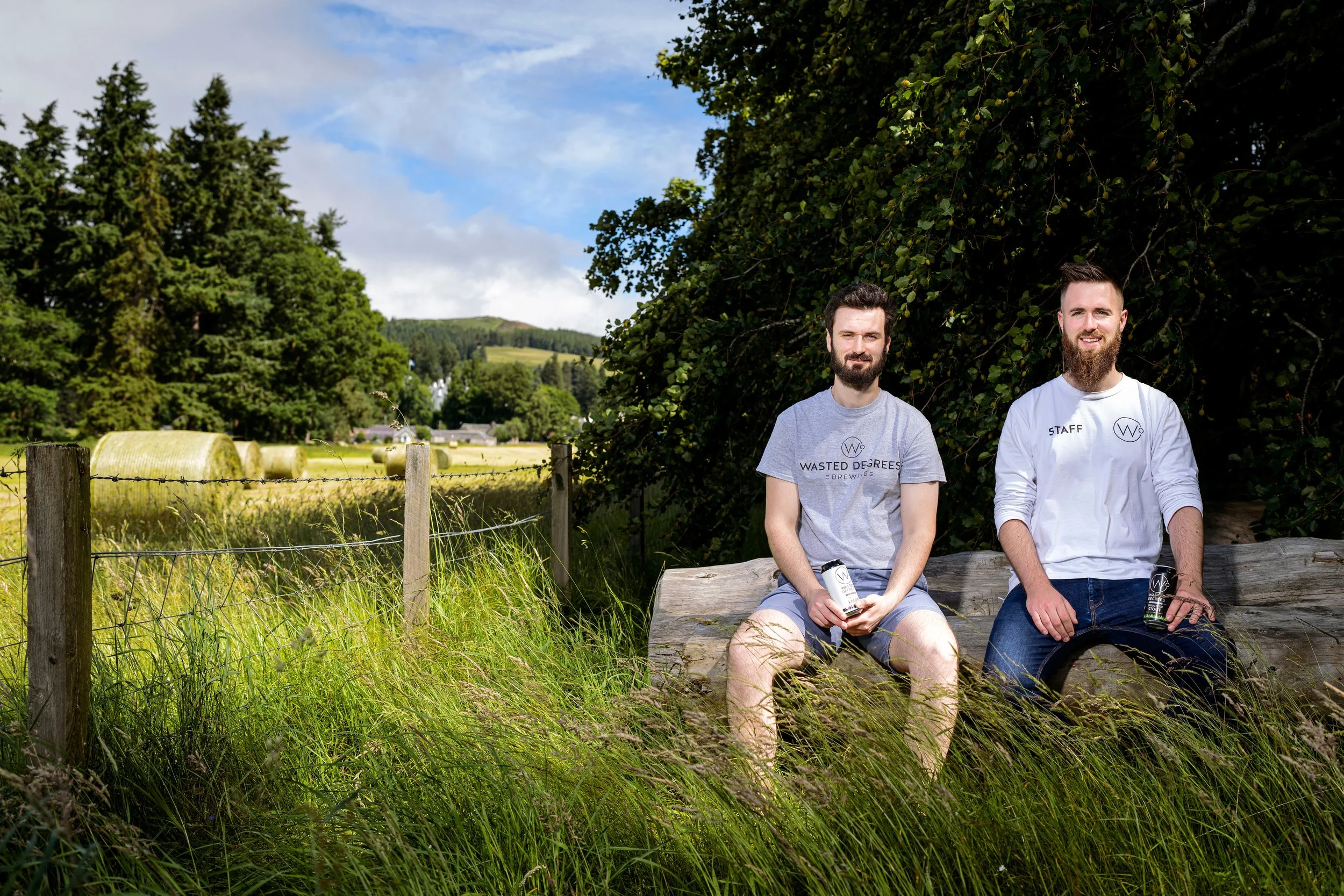
Jack Low, Wasted Degrees
In this interview, Jack Low tells the story so far of Perthshire craft beer company Wasted Degrees, and how they’ve grown sustainably from small beginnings.
Tell us how Wasted Degrees started?
It all began with my brother Conall and his business partner and mentor at the time, John.
Although both myself and Conall dabbled in home brew when we were younger, we both went to university to do different things. My background is in business growth from time spent in financial services and in the whisky industry. Conall followed the family trade and did a teaching degree, but his hobby was still home brewing. After a few years of teaching, he decided to give up a job for life, with some great benefits, and make beer instead! He quit his job, moved back to our parents’ house, and took over the garage with John, making small batches of 25-50 litres.
Back then everything was done manually, including bottling by hand, and they were selling the beer at local farmers markets.
I took an ownership stake in Wasted Degrees in late 2021, as John sought to retire. Over a period of about six months, I gradually weaned myself off a well established, well-paying and secure career elsewhere to come home to Perthshire and make beer with my brother. I swapped travel to Shanghai and Tokyo for a commute to Blair Atholl.
My reason was partly a desire to escape the corporate life, but I also saw it as a last chance opportunity to do something drastic with my working life before starting a family. I wanted complete control over my own destiny, rather than being a cog within a larger machine steered by someone else. And I was sick of wearing a suit to work.
My transition to Wasted Degrees was much like my brother’s, albeit it took me a few years longer to make that leap.
How has your business evolved over time?
We’ve made our peace with slower growth, but sustainably done: reinvesting profits, choosing salary sacrifice, and maintaining complete control in the sense of not owing money to a bank or other investors, so essentially debt free.
Although this means growth comes at a slower pace, we’ve still been able to grow by 50% - 75% percent every year, but we’ve done so under own steam, and we’ve deliberately oriented it locally, creating meaningful relationships with sellers and drinkers, and a nucleus of concentrated demand rather than it being diluted across the country. Although we do sell UK wide as well, and export to 13 countries—soon to be 15 with the addition of Iceland and Norway.
It’s important to us to invest what we have when we can, or save and then spend when we’re able to. This means our brewery is somewhat Frankenstein-ian, with lots of bits being added at different times!
Why is operating in a sustainable, eco-friendly way so important to you, and how have you been able to do that?
Sustainability means two things to us, people and planet.
We’re nothing without our people—staff and customers—so we do what we can to look after them and to set a strong example. One of the first things we did was become an accredited living wage employer. At the time we were one of less than 100 in Perth and Kinross. We also offer free period products at the brewery, partly in response to statistics in Scotland about rural period poverty. We get them from Hey Girls, which is based in Scotland, and they’re sustainably produced. Making a difference is actually easy to do, incremental change rather than wholesale. We find a lot of the choices we make are like that.
As for planet, we don’t stylise ourselves as environmental fundamentalists, we just follow a philosophy instilled in us by our grandparents: “Whatever you choose to do in life, try to leave things in a better state than when you found them.” This is the overarching way we behave as a company.
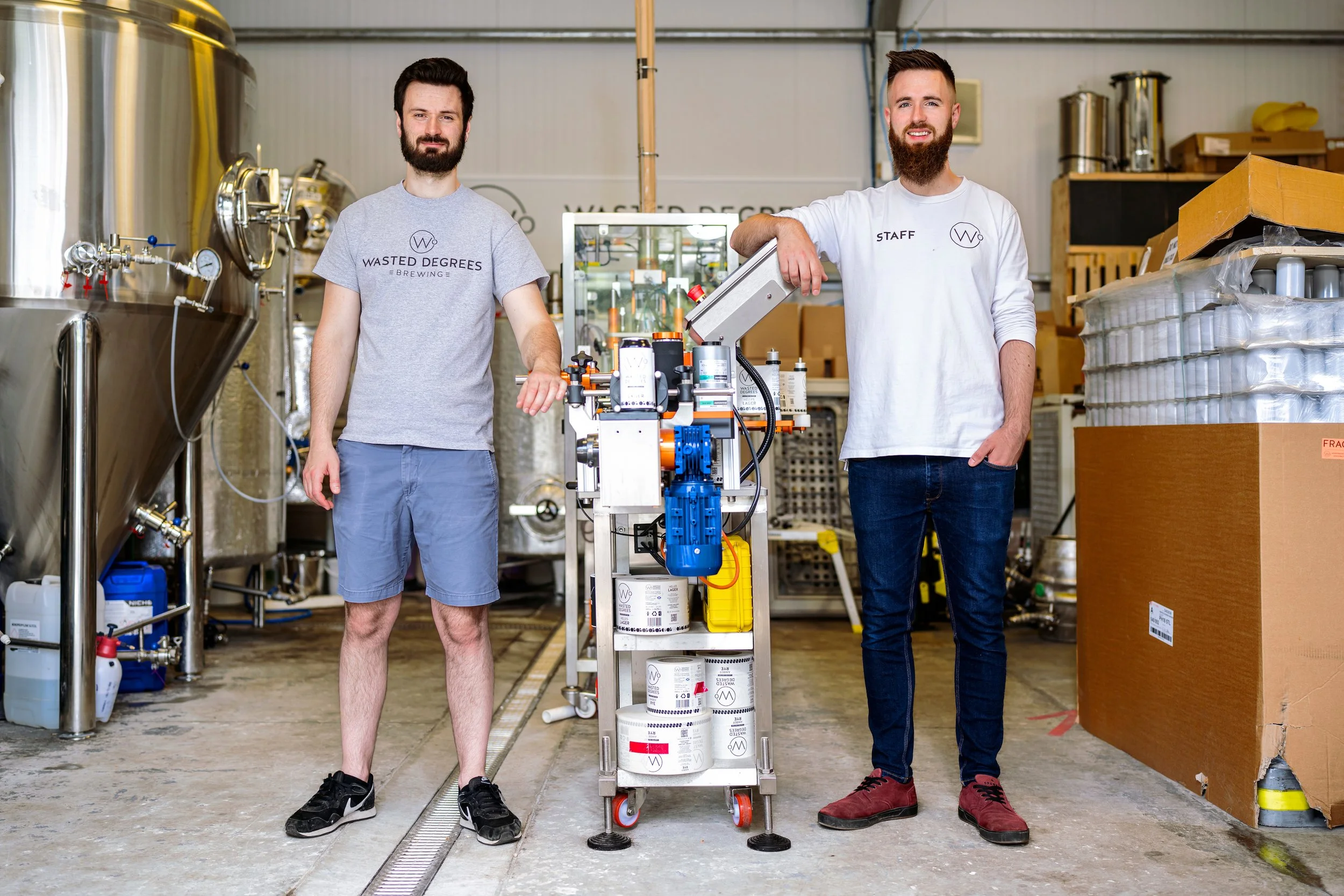
We brew exclusively on renewable power, we use cans instead of bottles, which have a 20% lower carbon footprint, and the labels we use on our cans are from plant-derived raw materials—recycled vegetable oil and tree resin—circular economic raw materials that perform like plastic (e.g. waterproof) but better for the planet.
In the last three years we’ve saved in excess of 21 tonnes of carbon, specifically from choosing to can our beers rather than bottle them. The cans also look after flavour & colour better than glass too. Win-win. Also, we’ve almost entirely removed plastic from our business and even use paper tape for parcels. This is another example of easy, incremental but impactful change!
All of our pale malt barley, around 95% of what we brew with, is grown at one family-owned farm just down the road in Perth, minimising food miles and maximizing investment in local agriculture. Then the bulk of our brewery draff (the spent grain) is sent to a farm three miles away for animal feed. This means we’ve created a circular economic story with local agriculture, it’s so satisfying.
These are all things that have been incrementally developed over time. We have to be open minded, looking at different solutions and, also, how we challenge ourselves. We’ve found it a useful way to approach problem solving.
What support has GrowBiz provided on your journey and what effect did it have?
GrowBiz for us is a reliable source of conversation and insights.
We don’t necessarily know what’s out there to help us grow, or have the contacts to have the right conversations at the right time. So, as a small company with limited human and financial resources, GrowBiz is a reliable and trustworthy partner to help realise what we want to achieve.
What has been the wider impact, on your family or community for example?
Being a business owner, or working in a small local business, gives a huge sense of freedom, a great perspective on the world as a ‘small guy’, and creates more flexibility than we otherwise would experience.
Tell us about your future plans
We have theproblem we want to have as a business: lots of demand but not enough space. So, the plan is to build a forever home for Wasted Degrees, one that’s capable of handling growth to a point, but we don’t want it to become a huge corporate beast of a company. Instead, we’ve designed a home that suits who we are.
Fundamentally, we want to contribute more economically—jobs, taxes, investments in local agriculture. The new home for the business is an enabler for all that. With any luck, this 2 million pound project will break ground later this year or early next year…